Humpback Whale Research with
Bob Marlin Charters
North Shore Oahu’s Seasonal Humpback Whale Watching Specialists
Our whale watching tours are led by Capt. GE, who holds a BS in Marine Biology from the University of Hawaiʻi at Mānoa and brings real research experience to every trip.
During his undergraduate studies, Capt. GE worked in marine research labs including the Pelagic Fish Research Lab at Coconut Island, assisting with shark tagging projects, and the Alan Friedlander Fisheries Ecology Lab, studying fish behavior and flight initiation distance in reef species. He also coauthored a scientific research paper as an undergraduate.
On board, guests experience science-based whale watching that goes beyond observation. Tours include discussions of whale behavior, migration patterns, and live hydrophone listening, allowing guests to hear whale vocalizations and learn how researchers study and interpret whale communication.
Our goal is to offer an educational, research-driven whale watching experience rooted in marine science and conservation.
In 2025, Capt. GE founded the North Pacific Humpback Whale Project, a long-term citizen science study tracking individual humpback whales — beginning with research on the North Shore of Oahu, Hawaii in 2019 and now expanded to Sitka, Alaska. Using fluke photo-identification — a method in which the unique pigmentation and shape of each whale's tail is used to identify individuals, much like a fingerprint — the project has catalogued over 300 individual whales across both regions. Every sighting is logged with GPS coordinates, behavioral notes, and photographic evidence, building a dataset that tracks migration routes, population health, and individual life histories over time. When the same whale is confirmed in both Hawaii and Alaska, it becomes a verified cross-match — direct evidence of a migration spanning more than 2,400 miles of open ocean. When you join a tour with Bob Marlin Charters (North Shore, Oahu) or Adventure Charters Sitka (Sitka, Alaska), you may be helping us identify one.
Check out our website !
https://northpacificwhaleproject.com
Whale behavior
Humpback whales in Hawaiʻi display a variety of surface and social behaviors. Common behaviors observed on our tours include:
-
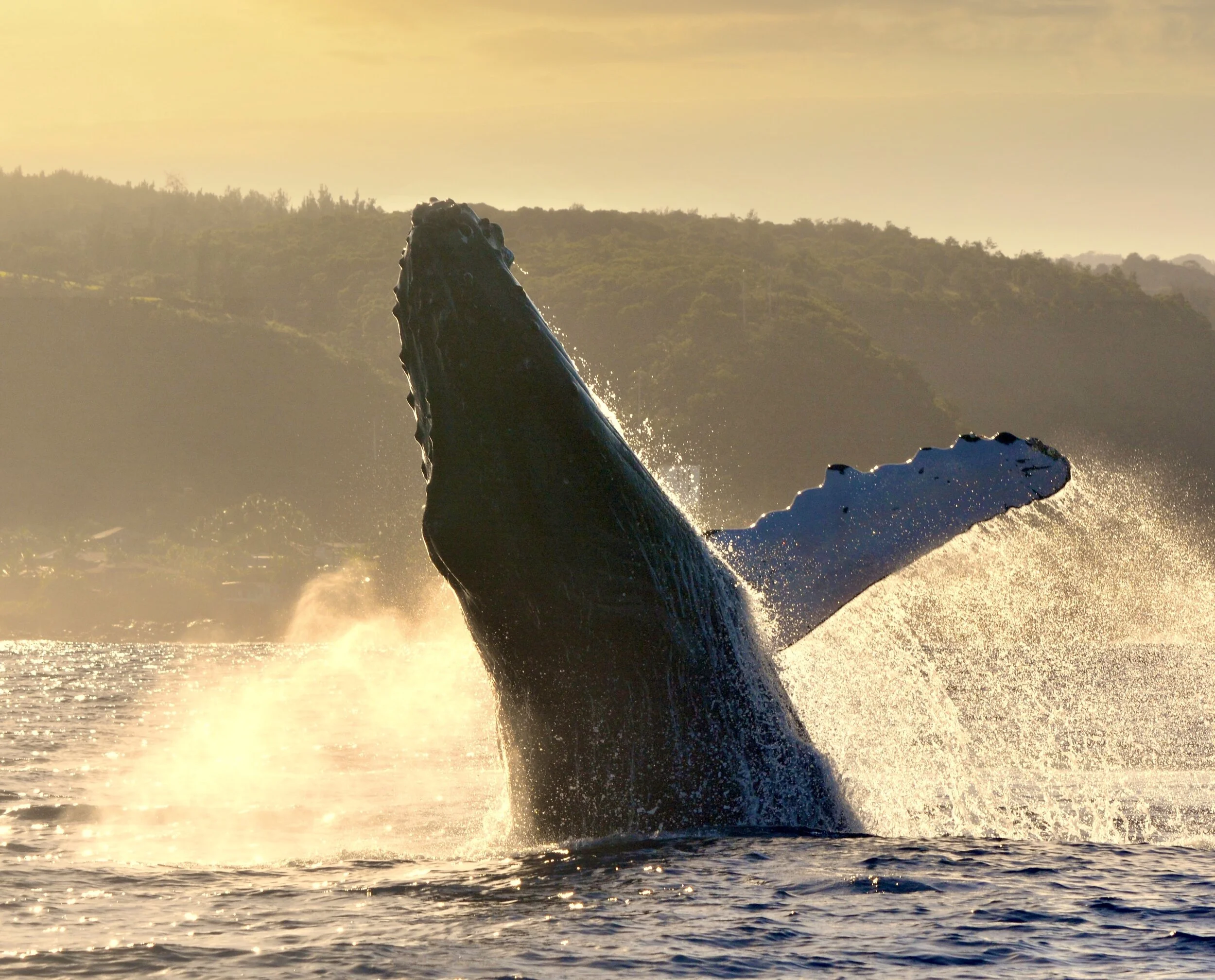
A whale propels most or all of its body out of the water before crashing back down. Breaching may play a role in communication, removing parasites, or social interaction.
-
The whale lifts one or both long pectoral fins and slaps them against the surface. This behavior is often associated with communication, play, or agitation.
-
A powerful forward or upward thrust of the tail stock (peduncle), usually without the full body leaving the water. Peduncle thrusts are commonly seen during competitive or aggressive interactions.
-
The whale thrusts its head upward or forward above the surface. This behavior is often linked to surface activity in competitive groups or social displays.
-
The whale repeatedly slaps its tail flukes on the surface of the water. Fluke slaps may function as a visual or acoustic signal to other whales.
-
The whale rises vertically with its head above the surface, appearing to look around. Spyhopping allows whales to visually observe their surroundings above water.
-
The whale rolls onto its side or back at the surface, sometimes exposing pectoral fins or flukes. Rolling is often associated with relaxed behavior, social interaction, or play.
These behaviors are interpreted on board to help guests understand humpback whale communication, social interactions, and energy use during the breeding season.
Hydrophone Listening On Board
A hydrophone is an underwater microphone used to detect and study whale vocalizations. On our whale watching tours, we use a hydrophone to listen to live whale sounds, giving guests insight into how whales communicate.
The hydrophone is lowered into the water to capture underwater sound waves, which are played through onboard speakers. Researchers use hydrophones to monitor whale presence, study whale communication and song, and connect vocalizations to observed surface behaviors.
Hydrophone listening allows for a deeper, research-based whale watching experience while promoting responsible, non-invasive observation.
Contributing to Whale Research with Happywhale
We actively contribute to Happywhale, a global whale research platform that uses fluke identification to track individual whales over time. By photographing the unique markings on the underside of a whale’s fluke, researchers can identify individuals and better understand migration patterns, site fidelity, and population connections across the Pacific and the world.
Fluke photos collected on our tours are submitted to Happywhale, helping scientists and conservationists study the movement and behavior of this population of whales while supporting long-term research and protection efforts.
Guests can get involved by submitting their own fluke photos to Happywhale, turning their whale sightings into real contributions to whale research and conservation.
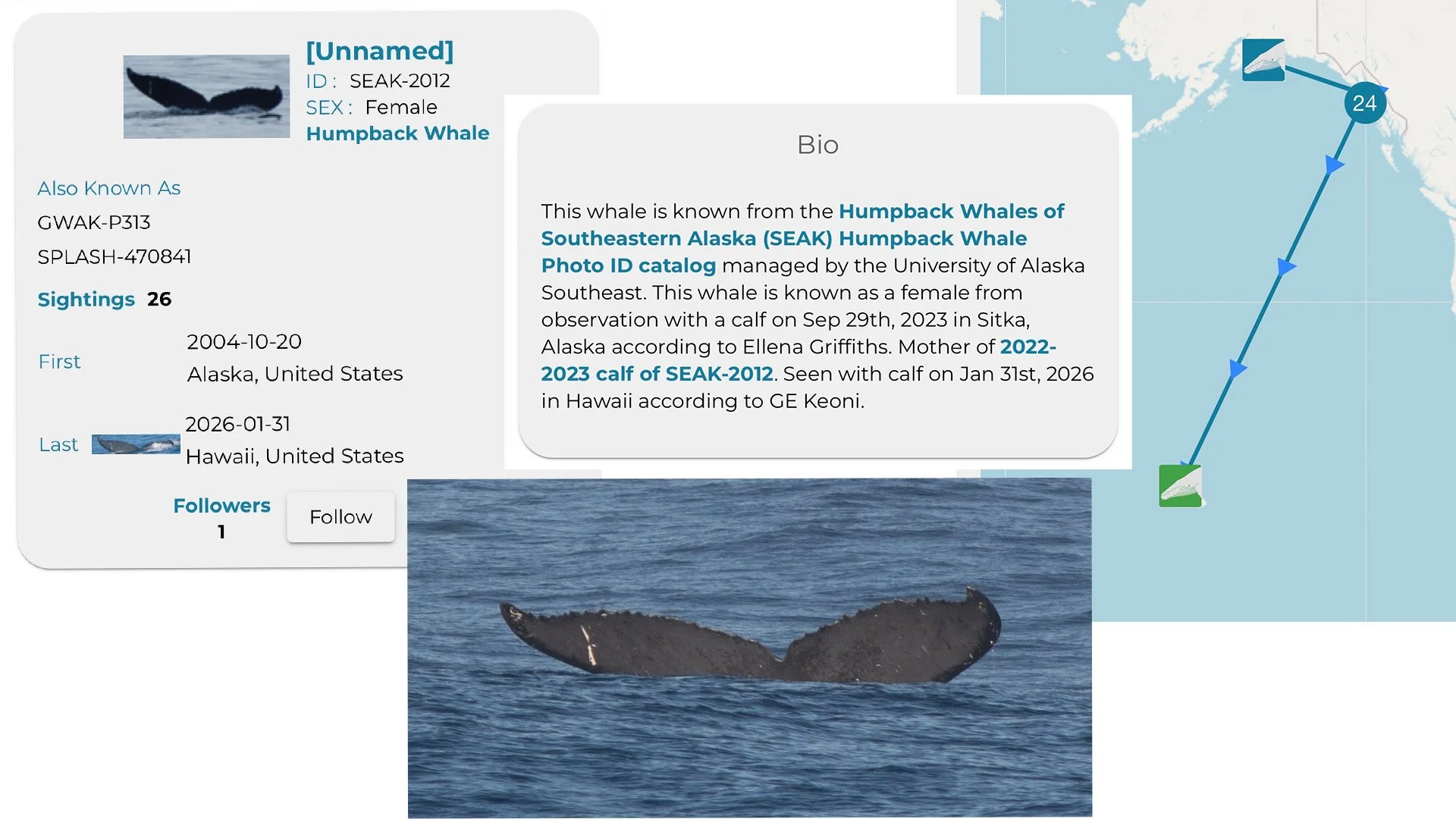
Each whale has a unique tail pattern, allowing researchers to track its movements, see where it has been spotted, when it was first and last seen, and whether it is male or female.
For example: A whale we documented on January 31st, 2026 has been sighted 24 times in SE Alaska/Canada and only once in Hawaiʻi. We are currently the only team to record her in Hawaiian waters during calving season, providing rare insights into this individual’s preferred birthing grounds. Every fluke photo we collect helps scientists study migration patterns, population connections, and family groups, supporting long-term whale conservation.